KYU-JUTSU
traditional Japanese archery
Choosing the correct bow length
It is extremely important to choose the correct length of bow. The bow length is
determined by two factors: The archer’s height and YAZUKA (arrow length).
Below is a chart to help determine the proper size bow.

YAZUKA (arrow length)
Common causes of damage and breakage of a TAKE YUMI· Storing or using the TAKE YUMI in excessive climatic conditions (extreme
heat, cold, moisture and dryness)
· Using the YUMI excessively without periods of rest
· Leaving the bow strung or unstrung for long periods which may cause the
bow to lose its proper shape
· Improper technique that causes the YUMI to twist counter-clockwise (HINERI)
at HIKIWAKE (draw), KAI (full draw) or HANARE (release) due to an improper
TENOUCHI (gripping the bow) or excessive strength or torque in the YUNDE
(left hand)
· Releasing the YUMI without an arrow
· Scratching or chipping the bamboo surface
· Over-drawing the YUMI due to improper bow length
· KUBIORE (breaks at SEKIITA) because the string twists upon release due to:
a) an improperly tied or sized TSURUWA (string loop)
b) the URAZORI (recurve) is too high (over 20 cm)
c) the KYUHA (width between grip and string) is too narrow (under 15 cm)
d) twisting bow is too strong
e) the YUMI is misshapen
TECHNICUE
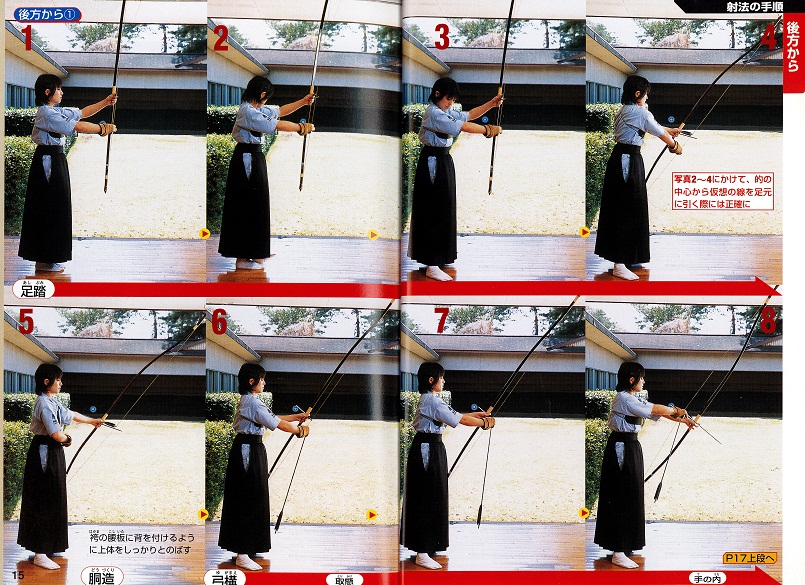
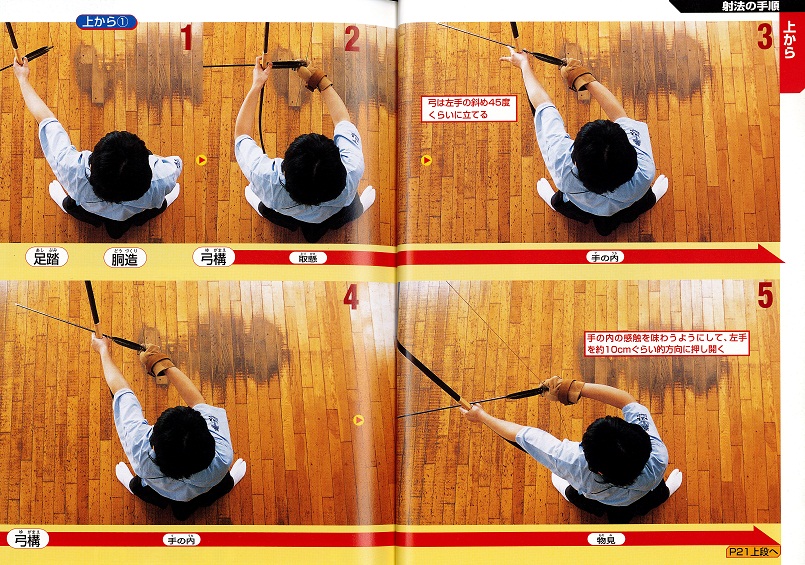
1 – ASHI BUMI2 – DOZUKURI
3 – YUGAMAE
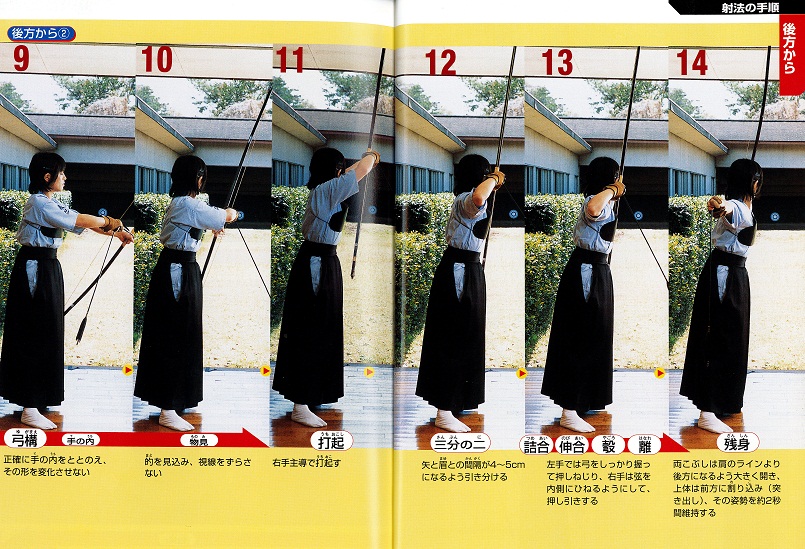
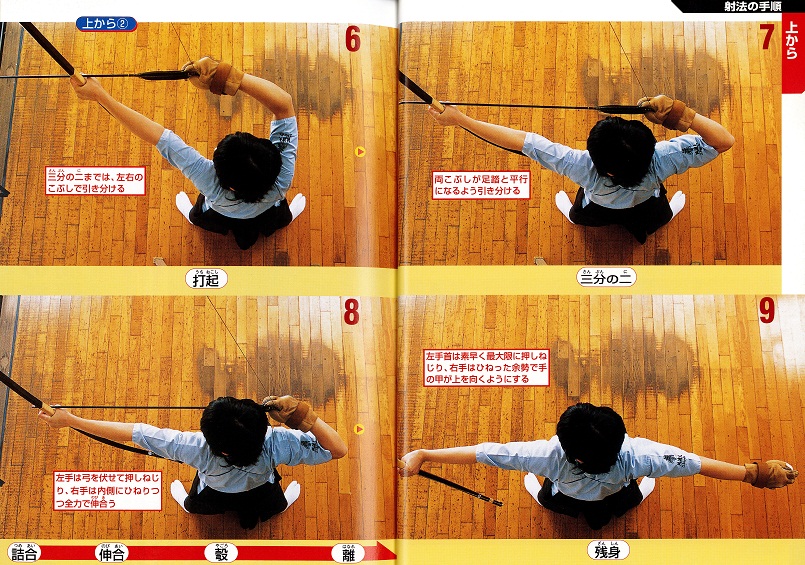
4 – UCHI OKOSHI
5 – SANBUN NO NI
6 – TSUME AI
7 – NOBI AI
8 – YAGORO
9 – HANARE
10 - ZANSHIN
More
POSITION
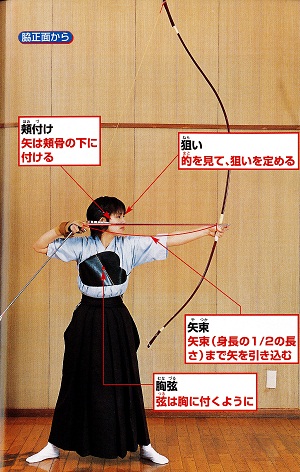 Position desctipion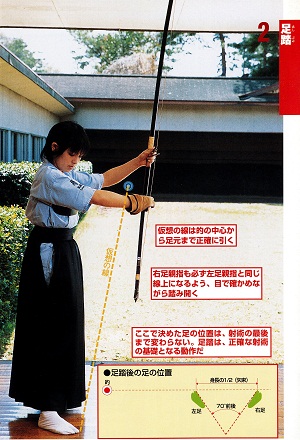
.
THE KINDS OF SHOOTING
There are five, followed by the word Mae which means "how to do"
1) MAKIWARA-MAE
The Makiwara is a very tight straw cylinder; its diameter is 40 or 60 cm and it is about 70 cm long and in general put on a wooden stand. It is used to learn both technique and ceremony; you shoot at the Makiwara from a distance of about 2m, the arrow has a bullet shaped point and usually no feathers. Among all the ceremonies the makiwara one is the most difficult, four arrows are shot.Makiwara practise teaches many things; there is no desire to hit and it is possible to study a single point for example Tsunomi or Nobi ai, so you should not underestimate the Makiwara.
2) MATO-MAE
It is the shooting at the distance of 28m. The diameter of the target is 36cm. It is usually stood in front of a bank of sand. It is good for learning the right technique and the right spirit.
3) ENTEKI
This is long distance shooting to 60m at a lm target. It is very good for developing a very strong Hanare; Ashi bumi is smaller than usual, if it is practised outdoors you keep the stringholder on your Hakama. Normally a lighter arrow with smaller feathers is used. You can shoot in two ways:the easier way involves bending the body sideways after Tsume ai; the other by inclining Sanbun no ni to lower the right hand. For aiming the reference is the same Mato position at Sanbun no ni as for Mato-Mae. Up to 60m there are no changes for the other stages of the shot.
To shoot further than 120m TOYA TECHNIQUE is better, very light arrows are employed, similar to those used in ancient times to send messages inserted in the s h a f t .
4) TEKI(Y0)-MAE
It is the method used on the battlefield when shooting in armour facing the enemy. This shot only has 3 stages: Yugamae, Sanbunoni and Nobi ai. The technique dispenses the Yugaeri.
5) KAZUYA-MAE
This is rapid shooting, 10 arrows in 60 seconds. The technique of the left hand and the stages are the same as for Teki(yo)-Mae, the right hand does not twist and Torikake is made with 4 fingers.
6) TOYA-MAE
Also called OKURIYA; flight shooting, to achieve maximum distance. It is done with very light arrows and when shooting further than 400m the feathers are cut gradually until only the rib of the feather remains which signifies to ask (check) the arrow if the shot is correct. From Insai Sensei to Inagaki Sensei only one Sensei shot with the feather rib.
There are five, followed by the word Mae which means "how to do"
1) MAKIWARA-MAE
The Makiwara is a very tight straw cylinder; its diameter is 40 or 60 cm and it is about 70 cm long and in general put on a wooden stand. It is used to learn both technique and ceremony; you shoot at the Makiwara from a distance of about 2m, the arrow has a bullet shaped point and usually no feathers. Among all the ceremonies the makiwara one is the most difficult, four arrows are shot.Makiwara practise teaches many things; there is no desire to hit and it is possible to study a single point for example Tsunomi or Nobi ai, so you should not underestimate the Makiwara.
2) MATO-MAE
It is the shooting at the distance of 28m. The diameter of the target is 36cm. It is usually stood in front of a bank of sand. It is good for learning the right technique and the right spirit.
3) ENTEKI
This is long distance shooting to 60m at a lm target. It is very good for developing a very strong Hanare; Ashi bumi is smaller than usual, if it is practised outdoors you keep the stringholder on your Hakama. Normally a lighter arrow with smaller feathers is used. You can shoot in two ways:the easier way involves bending the body sideways after Tsume ai; the other by inclining Sanbun no ni to lower the right hand. For aiming the reference is the same Mato position at Sanbun no ni as for Mato-Mae. Up to 60m there are no changes for the other stages of the shot.
To shoot further than 120m TOYA TECHNIQUE is better, very light arrows are employed, similar to those used in ancient times to send messages inserted in the s h a f t .
4) TEKI(Y0)-MAE
It is the method used on the battlefield when shooting in armour facing the enemy. This shot only has 3 stages: Yugamae, Sanbunoni and Nobi ai. The technique dispenses the Yugaeri.
5) KAZUYA-MAE
This is rapid shooting, 10 arrows in 60 seconds. The technique of the left hand and the stages are the same as for Teki(yo)-Mae, the right hand does not twist and Torikake is made with 4 fingers.
6) TOYA-MAE
Also called OKURIYA; flight shooting, to achieve maximum distance. It is done with very light arrows and when shooting further than 400m the feathers are cut gradually until only the rib of the feather remains which signifies to ask (check) the arrow if the shot is correct. From Insai Sensei to Inagaki Sensei only one Sensei shot with the feather rib.
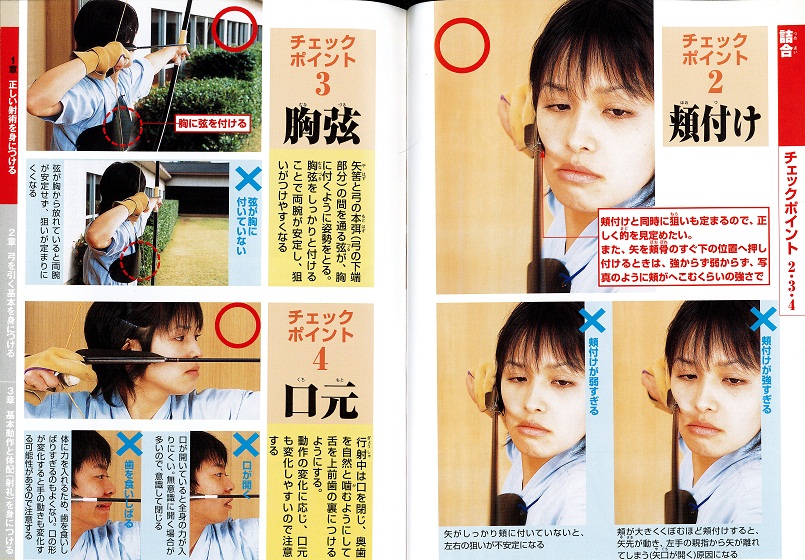 Check
Check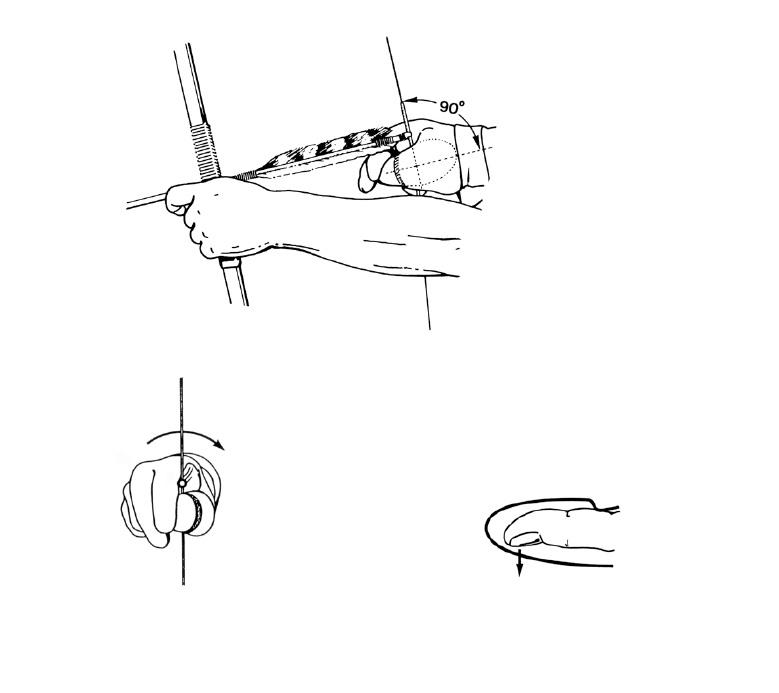 TORIKAKE, a) The thumb of the right hand must be perpendicular to the string._b)
The arrow must be pressed against the bow by a slight counterclockwise
rotation of the right forearm; this rotation must start lightly
and gradually increase from Yugamae to Sanbun no ni; at the same time
Teno uchi must tilt clockwise and increase according to the progressive
Torikake movement.
c) The index and the middle finger must exert an equal pressure on the
boushi (thumb of the glove). The pressure must be applied uniformly
along the length of the finger rather than being concentrated at the
finger tips.
